

The Story Behind
The Quiet Art of Edible Gold
Gold has fascinated humankind for millennia – for its permanence, its warm lustre and its almost unchanging beauty. Worked to extraordinary thinness, it becomes gold leaf: a material of quiet nobility.
It is neither a seasoning nor an aroma. Its effect lies entirely in light: a fine reflection, a warm shimmer, a detail that alters the expression of a dish without touching its flavour.
What appears so effortless on a praline, cake, dessert, cocktail or festive table is, in truth, the result of a long and highly sensitive manufacturing process. Solid gold is transformed into a film of almost unimaginable delicacy – so thin that a single breath is enough to move it.
The Craft Behind Gold Leaf
The process begins with pure gold or a high-purity gold alloy. According to the desired K designation and nuance of colour, the precious metal is weighed with precision, melted and cast into a small bar. This solid piece is then rolled into a fine ribbon of gold.
Even this first stage requires the utmost control. Gold is the most malleable of all metals, yet that very quality makes it demanding to work with. It must be stretched, rolled, annealed, cut and prepared again without compromising its structure. Small squares are cut from the ribbon and placed between specialised separating sheets. Only then does the actual beating process begin.
Under controlled hammering, the gold expands ever further. What began as a small piece of metal becomes larger, finer and more delicate. After every beating stage, the leaves must be prepared anew, restacked, cut and placed once more between protective sheets. This process is repeated until the gold reaches the almost inconceivable fineness that distinguishes genuine gold leaf.
The finished leaves are so thin that their thickness can only be expressed in fractions of a micrometre. Depending on its specification, classic gold leaf measures approximately 0.0001 to 0.000125 millimetres. In other words, some 8,000 to 10,000 leaves placed one upon another would together reach a height of only around one millimetre.
A comparison with human hair makes this delicacy more tangible. Hair varies considerably in thickness – from very fine blond hair to stronger, darker hair – so any comparison remains approximate. Even so, gold leaf is around 700 to 900 times thinner than an average human hair.
Its weight is equally difficult to imagine. A leaf measuring 80 × 80 mm weighs only approximately 0.013 to 0.016 grams, depending on its K designation, alloy, thickness and format. In purely mathematical terms, one kilogram of fully beaten gold leaf could cover an area of approximately 400 to 490 square metres. The area usable in practice is correspondingly smaller, depending on leaf thickness, cutting, overlap, application and yield. These figures reveal just how far gold can be extended – and how much craftsmanship resides in a material that appears almost weightless.
Why Gold Can Be Beaten So Thin
No other precious metal combines density, lustre, chemical stability and malleability in quite the same way. Gold can be beaten thinner than other metals without tearing. It was this quality that made gold leaf possible even in antiquity – for temples, icons, works of art, domes and manuscripts, and later for the refined culture of the table.
Historically, gold leaf was beaten entirely by hand. This craft demanded exceptional experience, patience and physical strength. Modern production methods now allow far greater consistency and more precise control of leaf thickness. Even so, gold leaf is still not a purely industrial product: the material is too delicate, and every stage too exacting.
The final stages call for the finest handwork of all. Each leaf must be inspected, cut to size and carefully placed into a booklet. Leaf by leaf. By hand. Without haste. Without pressure. Finished gold leaf allows no careless movement.


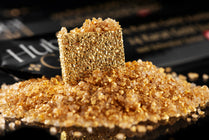
22K, 23K and 24K – The Differences
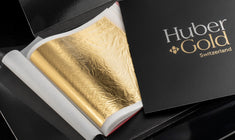
Loose Gold Leaf and Transfer Gold Leaf

Gold Flakes, Gold Powder and Special Shapes
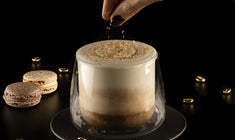
Applications in Cuisine and Pâtisserie
